
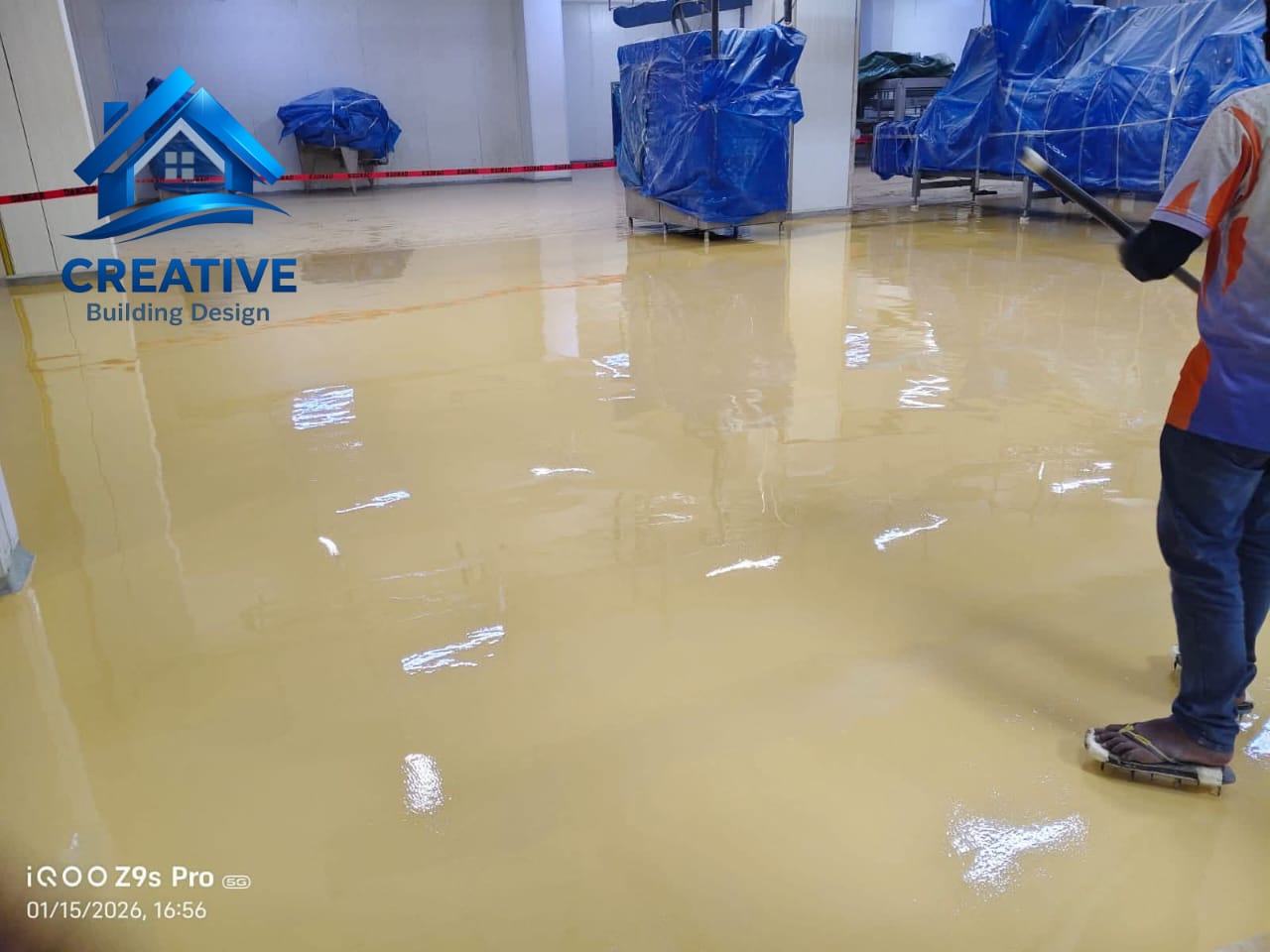
Epoxy flooring is a high-performance surface coating system created by mixing epoxy resin with a hardening agent. When these two components combine, they form a strong, rigid plastic-like material that bonds tightly to concrete surfaces. This creates a seamless, glossy, and highly durable floor that is widely used in industrial, commercial, and residential environments.
Unlike traditional flooring materials such as tiles or wood, epoxy does not have joints or gaps. This makes it highly resistant to dust, moisture, chemicals, and heavy impact. Because of its durability and aesthetic flexibility, epoxy flooring has become one of the most preferred flooring solutions worldwide, including in Bangladesh.
Epoxy flooring is not just a surface coating—it is a protective shield that enhances the lifespan of the underlying concrete while improving the visual appeal of the space.
Key Features of Epoxy Flooring
Epoxy flooring is known for several standout features:
- Seamless and smooth surface
- High resistance to chemicals and oil
- Strong mechanical strength
- Long-lasting durability
- Attractive glossy finish
- Easy to clean and maintain
These features make epoxy flooring suitable for factories, warehouses, garages, hospitals, shopping malls, and even modern homes.
Types of Epoxy Flooring Solutions
Self-Leveling Epoxy Flooring
Self-leveling epoxy is designed to create a smooth and even surface over old or damaged concrete floors. It flows across the floor and automatically levels itself, making it ideal for industrial and commercial spaces where aesthetics and durability are both important.
This type is commonly used in offices, warehouses, and showrooms due to its clean and professional finish.
Epoxy Mortar Flooring
Epoxy mortar flooring is one of the strongest epoxy systems available. It is created by combining epoxy resin with graded sand or quartz. This results in an extremely durable surface that can withstand heavy machinery, high traffic, and severe impact.
It is widely used in factories, production units, and heavy industrial areas.
Epoxy Flake Flooring
Epoxy flake flooring includes decorative vinyl flakes added to the epoxy layer. These flakes provide a textured, colorful, and visually appealing finish. This type is popular in residential garages, shopping centers, and recreational areas.
It is not only decorative but also slip-resistant.
Anti-Static Epoxy Flooring
Anti-static epoxy flooring is specially designed for environments where static electricity can be dangerous. It is commonly used in electronic manufacturing units, laboratories, and data centers.
This flooring helps prevent damage to sensitive electronic equipment.
Epoxy Flooring Installation Process
Surface Preparation
Proper surface preparation is the most important step in epoxy flooring installation. The concrete surface must be cleaned, repaired, and free from dust, oil, and moisture. Any cracks or damages are filled before applying the epoxy layer.
Grinding or shot blasting is often used to ensure strong adhesion between the concrete and epoxy coating.
Primer Application
A primer coat is applied to enhance bonding strength. This layer penetrates the concrete and creates a strong base for the epoxy system.
Epoxy Mixing and Application
Epoxy resin and hardener are mixed in a specific ratio. The mixture is then applied evenly across the floor using rollers or squeegees.
Depending on the system, multiple layers may be applied to achieve the desired thickness and strength.
Curing Process
After application, the epoxy needs time to cure and harden. This process may take 24 to 72 hours depending on temperature and humidity conditions.
Once fully cured, the floor becomes extremely strong and ready for use.
Applications of Epoxy Flooring
Industrial Use
Epoxy flooring is widely used in factories, warehouses, and manufacturing plants. It can withstand heavy machinery, chemical spills, and continuous foot traffic.
Commercial Spaces
Shopping malls, showrooms, offices, and restaurants use epoxy flooring for its modern appearance and easy maintenance.
Residential Use
Homeowners use epoxy flooring in garages, kitchens, and living spaces for its stylish finish and durability.
Healthcare and Laboratories
Hospitals and labs prefer epoxy flooring due to its hygienic, dust-free, and antibacterial properties.
Advantages of Epoxy Flooring in Bangladesh
Climate Resistance
Bangladesh has a humid and tropical climate. Epoxy flooring performs well under moisture-rich conditions and prevents water damage.
Cost-Effective Solution
Compared to tiles or marble, epoxy flooring offers long-term cost savings due to its durability and low maintenance requirements.
Fast Installation
Epoxy flooring can be installed quickly, reducing downtime for businesses and industrial operations.
Modern Aesthetic Appeal
With a glossy and customizable finish, epoxy flooring enhances the visual appeal of any space.
Maintenance of Epoxy Flooring
Easy Cleaning Process
Epoxy floors require simple cleaning using a mop and mild detergent. Dust and dirt do not easily stick to the surface.
Long-Term Durability
With proper care, epoxy flooring can last 10–20 years without major repairs.
Damage Prevention
Avoid dragging heavy sharp objects directly on the surface to maintain its shine and finish.
Cost Factors of Epoxy Flooring Solution
Material Quality
Higher-quality epoxy materials increase durability and overall cost but ensure long-lasting performance.
Surface Condition
If the existing floor requires heavy repair or leveling, installation costs may increase.
Project Size
Larger areas often reduce per-square-foot cost due to bulk application efficiency.
Design Requirements
Decorative finishes such as flake or metallic epoxy may cost more than standard coatings.
Why Choose CreativeEpoxyBD?
Professional Expertise
www.creativeepoxybd.com provides professional epoxy flooring solutions with experienced technical teams who understand industrial and residential requirements.
High-Quality Materials
We use premium-grade epoxy materials that ensure long-lasting performance, durability, and aesthetic excellence.
Customized Solutions
Every project is designed based on client needs, whether it is industrial flooring, commercial space, or residential design.
Reliable Service
We ensure timely project completion, proper installation, and customer satisfaction with every project.
Why Epoxy Flooring is Becoming a Global Standard?
Epoxy flooring is no longer just an industrial choice—it has become a global standard for modern flooring systems. Its rising popularity comes from its ability to combine strength, hygiene, design flexibility, and long-term cost efficiency in one solution.
Industries across the world prefer epoxy because it reduces maintenance downtime and increases operational efficiency. In Bangladesh, epoxy flooring is gaining massive demand in garments factories, pharmaceutical units, warehouses, and modern homes due to rapid urbanization.
Unlike traditional flooring systems, epoxy creates a chemical-bonded surface layer that becomes part of the concrete itself, rather than sitting on top of it. This is why it does not easily peel or detach when installed properly.
Technical Composition of Epoxy Flooring
Epoxy Resin and Hardener Chemistry
Epoxy flooring is based on a thermosetting polymer system. It involves:
- Epoxy Resin (Base Material)
- Polyamine or Polyamide Hardener
When mixed, these two components undergo a chemical cross-linking reaction that transforms liquid epoxy into a solid, rock-hard surface.
This reaction is irreversible, meaning once cured, the flooring cannot return to its liquid state. This gives epoxy its exceptional durability and resistance.
Additives Used in Epoxy Systems
To improve performance, different additives are included:
- Quartz sand for strength
- Pigments for color customization
- Anti-slip materials for safety
- UV stabilizers for outdoor protection
- Conductive materials for anti-static systems
These additives allow epoxy flooring to be customized for industrial, decorative, and specialized applications.
Industrial Strength Performance
Heavy Load Resistance
Epoxy flooring can withstand:
- Forklifts
- Heavy machinery
- Continuous vehicle movement
- High-impact drops
This makes it ideal for factories and logistics hubs where floor durability is critical.
Chemical Resistance
Epoxy flooring resists:
- Acids
- Alkalis
- Oils and grease
- Industrial solvents
- Cleaning chemicals
This is why it is widely used in pharmaceutical plants, chemical industries, and food processing units.
Abrasion Resistance
In high-traffic environments, floors often degrade due to friction. Epoxy flooring is engineered to resist:
- Constant foot traffic
- Rubber tire abrasion
- Machine movement stress
This ensures long-term structural integrity even under extreme use.
Environmental Benefits of Epoxy Flooring
Reduced Material Waste
Since epoxy is applied directly over existing concrete, it reduces the need for removing old flooring materials. This helps minimize construction waste.
Energy Efficient Surfaces
Light-colored epoxy floors reflect light better than traditional flooring, which reduces indoor lighting requirements in large industrial areas.
Long Lifespan = Less Replacement
Because epoxy flooring lasts many years, it reduces the need for frequent replacements, which lowers environmental impact over time.
Safety Features of Epoxy Flooring
Anti-Slip Technology
Special anti-slip coatings are added to prevent accidents in:
- Wet areas
- Industrial kitchens
- Loading zones
Fire Resistance
Epoxy coatings have moderate fire-resistant properties and do not easily ignite, making them safer than many synthetic flooring options.
Hygienic Surface
Since epoxy is seamless and non-porous:
- No bacteria growth
- No dust accumulation in joints
- Easy sanitization
This is especially important for hospitals and food industries.
Design and Aesthetic Advancements
Metallic Epoxy Flooring
This is a premium decorative style where metallic pigments create a 3D flowing effect. It is widely used in:
- Luxury homes
- Showrooms
- Hotels
3D Epoxy Effects
Advanced epoxy systems can create marble-like or water-flow visual effects, enhancing interior aesthetics significantly.
Color Customization
Epoxy flooring can be produced in:
- Solid colors
- Dual-tone designs
- Branding colors for companies
- Safety color zoning in factories
Epoxy Flooring Challenges and Solutions
Moisture Problems
Excess moisture in concrete can cause bubbling. This is solved using:
- Moisture barrier primers
- Proper surface drying techniques
Surface Cracking Issues
If the base concrete is weak, cracks may appear. Solutions include:
- Crack injection repair
- Epoxy mortar reinforcement
UV Exposure Fading
Outdoor epoxy may fade under sunlight unless UV-stable coatings are used.
Future of Epoxy Flooring in Bangladesh
Growing Industrial Demand
Bangladesh’s industrial growth is increasing demand for:
- Garments factory flooring
- Export warehouse systems
- Pharmaceutical production floors
Residential Market Expansion
Modern homeowners now prefer epoxy due to:
- Minimal maintenance
- Luxury appearance
- Long-term durability
Smart Flooring Systems
Future epoxy systems may include:
- Temperature-resistant coatings
- Smart anti-bacterial layers
- Self-healing coatings (emerging technology)
Advanced Technical Properties of Epoxy Flooring
Chemical Bonding Mechanism
Epoxy flooring works through a chemical cross-linking reaction between epoxy resin and a curing agent. Once mixed, the molecules form a three-dimensional network structure. This structure is what gives epoxy its:
- Extreme hardness
- High adhesion strength
- Resistance to deformation
- Long-term stability
Unlike paint or surface coatings, epoxy does not simply dry—it chemically cures into a solid polymer system. This is why it bonds permanently with concrete.
Adhesion Strength to Concrete
One of the strongest advantages of epoxy flooring is its exceptional adhesion strength. It penetrates the pores of concrete and forms a mechanical grip.
Typical adhesion strength levels:
- 2–4 MPa (standard systems)
- 5–8 MPa (industrial-grade systems)
This strong bonding prevents peeling, lifting, or delamination when properly installed.
Compressive Strength Performance
Epoxy flooring significantly improves the load-bearing capacity of concrete surfaces.
- Standard concrete: ~20–30 MPa
- Epoxy-coated systems: can exceed 80 MPa depending on formulation
This makes epoxy ideal for heavy industrial environments where forklifts and machinery operate continuously.
Surface Preparation Importance (Critical Factor)
Why Preparation Determines 80% of Success
In epoxy flooring, surface preparation is the most critical stage. Even the highest-quality epoxy will fail if the surface is not properly prepared.
Mechanical Grinding Method
Grinding removes:
- Weak surface laitance
- Old coatings
- Dust and contaminants
It also creates a rough profile (CSP level 2–5) that improves bonding strength.
Shot Blasting Method
Shot blasting is used for heavy industrial floors. It:
- Cleans deeply embedded contaminants
- Opens concrete pores
- Ensures maximum adhesion
This method is commonly used in warehouses and factories.
Moisture Testing Before Application
Excess moisture can destroy epoxy adhesion. Professional installers test:
- Relative humidity of concrete
- Vapor emission rate (MVER)
If moisture exceeds safe limits, a moisture barrier system is applied.
Advanced Epoxy Flooring Systems
High-Build Epoxy System
This system applies epoxy in thick layers (2–5 mm). It is used for:
- Heavy machinery zones
- High-impact industrial floors
- Chemical processing areas
It provides enhanced durability and crack resistance.
Self-Smoothing System
A self-smoothing epoxy system flows evenly and creates a mirror-like surface finish. It is ideal for:
- Laboratories
- Clean rooms
- Commercial showrooms
It eliminates surface imperfections and creates a seamless appearance.
Quartz-Filled Epoxy System
Quartz epoxy combines resin with silica sand. Benefits include:
- Extremely high abrasion resistance
- Anti-slip texture
- Superior mechanical strength
This system is widely used in loading docks and industrial kitchens.
Polyurethane-Modified Epoxy
This hybrid system improves:
- Flexibility
- UV resistance
- Temperature stability
It is suitable for semi-outdoor environments.
Mechanical Performance Under Stress
Impact Resistance
Epoxy flooring can absorb impact energy from:
- Falling tools
- Heavy equipment drops
- Continuous vibration
This reduces surface cracking and structural damage.
Flexural Strength
Epoxy systems improve the floor’s ability to withstand bending forces caused by:
- Heavy load movement
- Uneven pressure distribution
- Structural settling
This prevents surface failure over time.
Thermal Shock Resistance
Advanced epoxy systems can withstand rapid temperature changes such as:
- Hot water washing in factories
- Cold storage environments
- Industrial heating zones
This makes epoxy suitable for food processing and pharmaceutical industries.
Hygiene and Cleanroom Performance
Seamless Surface Advantage
Since epoxy flooring has no joints or grout lines:
- No dirt accumulation
- No microbial growth
- No bacterial trapping zones
This makes it ideal for sterile environments.
FDA-Compliant Systems
Certain epoxy formulations meet food safety standards, making them suitable for:
- Food production units
- Beverage factories
- Packaging industries
Anti-Bacterial Coatings
Modern epoxy systems can include silver-ion or antimicrobial additives that:
- Prevent bacterial growth
- Reduce contamination risk
- Improve hygiene compliance
Industrial Safety Enhancements
Line Marking Integration
Epoxy flooring allows integrated safety markings such as:
- Walkways
- Hazard zones
- Machine boundaries
- Storage areas
These markings do not fade easily because they are embedded into the coating system.
Reflective Brightness Factor
Epoxy floors increase light reflection by up to 300%, improving:
- Visibility in warehouses
- Worker safety
- Energy efficiency
Chemical Spill Protection
In industrial environments, epoxy acts as a protective barrier against:
- Acid spills
- Oil leakage
- Solvent exposure
This prevents concrete corrosion and long-term structural damage.
Long-Term Durability Engineering
Wear Layer Concept
Epoxy flooring systems are designed with a wear layer, which is the top protective surface. This layer absorbs daily stress and protects the base coating.
Recoating Capability
One major advantage is that epoxy floors can be:
- Recoated
- Refreshed
- Upgraded
without removing the existing system, reducing maintenance costs.
Life Cycle Performance
Depending on usage:
- Light commercial: 10–15 years
- Industrial heavy-duty: 5–10 years
- Decorative residential: 15–20 years
Environmental Stress Resistance
Humidity Resistance
Epoxy performs well in humid climates like Bangladesh because it:
- Blocks moisture penetration
- Prevents mold growth
- Maintains surface stability
Salt and Corrosion Resistance
In coastal or high-salinity environments, epoxy protects concrete from:
- Saltwater damage
- Corrosion of reinforcement steel
- Surface erosion
UV Degradation Control
UV exposure can degrade epoxy over time, but modern systems use:
- UV-stable polyurethane topcoats
- Aliphatic hardeners
These prevent yellowing and fading.
Installation Environment Requirements
Temperature Conditions
Ideal installation temperature:
- 20°C to 30°C
Extreme cold slows curing, while excessive heat accelerates it unevenly.
Humidity Control
Best installation humidity:
- Below 75% RH
High humidity can cause:
- Blistering
- Poor adhesion
- Surface cloudiness
Dust-Free Environment
Epoxy must be applied in controlled environments to avoid:
- Dust contamination
- Air bubbles
- Surface defects
Common Epoxy Flooring Failures (and Causes)
Peeling or Delamination
Caused by:
- Poor surface preparation
- Moisture in concrete
- Incorrect mixing ratio
Bubble Formation
Caused by:
- Air trapped in substrate
- Rapid curing conditions
- Moisture vapor pressure
Color Inconsistency
Caused by:
- Uneven mixing
- Poor pigment dispersion
- Layering errors
Industrial Trend: Smart Epoxy Flooring
Sensor-Embedded Floors (Future Technology)
Emerging systems include:
- Load monitoring sensors
- Temperature tracking systems
- Structural health monitoring
Self-Healing Coatings (Advanced Research)
New epoxy technologies aim to:
- Automatically repair micro-cracks
- Extend lifespan significantly
- Reduce maintenance costs
About Us – CreativeEpoxyBD
www.creativeepoxybd.com is a professional epoxy flooring solution provider dedicated to delivering high-quality flooring systems across Bangladesh. We specialize in industrial, commercial, and residential epoxy flooring installations with a strong focus on durability, design, and customer satisfaction.
Our team consists of skilled professionals with hands-on experience in surface preparation, epoxy application, and finishing techniques. We use advanced materials and modern technology to ensure long-lasting and visually appealing results for every project.
At CreativeEpoxyBD, we believe in providing flooring solutions that combine strength, beauty, and functionality. Whether it is a factory floor, showroom, office space, or home interior, we deliver customized solutions tailored to client requirements.
Our mission is to become a leading epoxy flooring service provider in Bangladesh by maintaining quality, trust, and innovation in every project we undertake.
Who We Are?
www.creativeepoxybd.com is a specialized epoxy flooring solution provider committed to delivering world-class flooring systems in Bangladesh. We focus on industrial, commercial, and residential epoxy applications that combine strength, beauty, and long-lasting performance.
Our Expertise
We provide complete epoxy solutions including:
- Surface preparation and concrete repair
- Industrial epoxy flooring systems
- Decorative metallic and flake flooring
- Anti-static and chemical-resistant coatings
- Warehouse and factory flooring systems
Our Commitment
At CreativeEpoxyBD, we are committed to:
- High-quality workmanship
- Use of premium materials
- Timely project delivery
- Customer satisfaction
- Long-term flooring durability
Our Vision
Our vision is to become the most trusted epoxy flooring brand in Bangladesh by delivering innovative, durable, and aesthetic flooring solutions for every industry and home.
Advanced Engineering Concepts in Epoxy Flooring
Polymer Cross-Link Density and Its Effect on Strength
The performance of epoxy flooring is strongly influenced by cross-link density, which refers to how tightly the polymer chains are bonded after curing.
- Higher cross-link density → higher hardness and chemical resistance
- Lower cross-link density → more flexibility but less durability
Industrial-grade epoxy systems are engineered with optimized cross-link ratios to balance:
- Mechanical strength
- Flexibility under load
- Thermal stability
This is why epoxy can be customized for different environments like warehouses, labs, or residential floors.
Glass Transition Temperature (Tg)
Epoxy flooring has a key property called glass transition temperature.
- Below Tg → epoxy is hard and rigid
- Above Tg → epoxy becomes slightly flexible
High-performance epoxy systems are designed with a Tg range of 50°C to 120°C, depending on formulation.
This is important in tropical climates where floor surfaces may heat up significantly.
Surface Science of Epoxy Adhesion
Mechanical Interlocking Theory
Epoxy does not just stick chemically—it also locks mechanically into concrete.
Concrete surfaces have microscopic pores. When epoxy is applied:
- It flows into pores
- It hardens inside them
- It creates a “lock-and-key” structure
This is called mechanical interlocking, which significantly increases durability.
Surface Energy and Wetting
For epoxy to bond properly, the concrete must have high surface energy.
If oil, dust, or moisture lowers surface energy:
- Epoxy cannot spread evenly
- Weak bonding occurs
- Peeling risk increases
This is why degreasing and grinding are essential.
Heavy Industrial Applications
Automotive Industry Floors
Epoxy is widely used in:
- Car manufacturing plants
- Service workshops
- Showrooms
Benefits include:
- Resistance to oil and grease
- Tire mark resistance
- Easy cleaning from hydraulic fluids
Textile and Garment Factories
In Bangladesh, epoxy is heavily used in textile industries because it:
- Reduces dust contamination
- Improves cleanliness standards
- Handles high worker traffic
Pharmaceutical Clean Rooms
Epoxy flooring supports GMP (Good Manufacturing Practice) environments:
- No microbial growth
- Seamless sterile surface
- Easy disinfectant compatibility
Cold Storage Facilities
Special epoxy formulations work at low temperatures:
- Down to -30°C in some systems
- Prevent cracking due to thermal contraction
- Resist freeze-thaw cycles
Advanced Surface Finishes
Matte Epoxy Finish
A non-glossy finish used where glare reduction is important:
- Hospitals
- Laboratories
- Office environments
It reduces eye strain and improves visual comfort.
High-Gloss Reflective Finish
Used for aesthetic and lighting efficiency:
- Showrooms
- Malls
- Luxury homes
It increases brightness by reflecting artificial lighting.
Orange Peel Texture Finish
This finish has a slight textured surface resembling orange skin:
- Improves slip resistance
- Hides minor imperfections
- Common in industrial floors
Epoxy Flooring Failure Analysis (Deep Technical)
Osmotic Blistering
One of the most critical failures.
Cause:
- Moisture trapped under epoxy
- Vapor pressure builds bubbles
Solution:
- Moisture barrier primer
- Proper curing time for concrete
Cohesive Failure vs Adhesive Failure
- Cohesive failure → epoxy breaks within itself (material weakness)
- Adhesive failure → epoxy separates from concrete (bonding issue)
Adhesive failure is more common and usually caused by poor surface preparation.
Pinholes Formation
Pinholes are tiny air cavities caused by:
- Entrapped air during mixing
- Porous concrete releasing gases
- High temperature curing
Solution:
- Use air-release rollers
- Apply primer coats
- Proper substrate sealing
Chemical Engineering Behind Epoxy Resistance
Acid Resistance Mechanism
Epoxy resists acids due to:
- Dense polymer network
- Lack of reactive sites for acid attack
However, strong acids like sulfuric acid may still degrade surface over time in unprotected systems.
Alkali Resistance
Epoxy performs very well in alkaline environments such as:
- Cement plants
- Cleaning chemical exposure areas
It maintains structural integrity under high pH conditions.
Solvent Resistance
Epoxy resists hydrocarbons like:
- Diesel
- Petroleum oils
- Industrial solvents
But long-term exposure to aggressive solvents may require specialized coatings.
Structural Reinforcement Role of Epoxy
Crack Bridging Ability
Flexible epoxy systems can bridge micro-cracks in concrete:
- Prevents crack propagation
- Extends structural lifespan
- Maintains surface integrity
Load Distribution Enhancement
Epoxy spreads point loads over a wider area:
- Reduces concrete stress concentration
- Prevents localized damage
- Improves floor lifespan
Environmental Interaction Behavior
Moisture Vapor Transmission Rate (MVT)
Concrete naturally releases vapor. If MVT is high:
- Epoxy may blister
- Adhesion weakens
Modern systems include vapor-block primers to control this.
Thermal Expansion Compatibility
Concrete and epoxy expand at different rates.
Engineered systems balance:
- Expansion coefficient mismatch
- Prevents cracking under temperature changes
Advanced Safety Engineering
Electrostatic Discharge (ESD) Control
ESD epoxy flooring is used in:
- Electronics manufacturing
- Server rooms
- Semiconductor plants
It safely dissipates static electricity to ground.
Slip Resistance Rating Systems
Epoxy floors can be engineered to meet:
- R9 (low grip)
- R10–R11 (medium grip)
- R12–R13 (high industrial grip)
This ensures safety compliance in different industries.
Maintenance Science of Epoxy Floors
Micro-Surface Wear Behavior
Even though epoxy is durable, microscopic wear occurs due to:
- Abrasion from footwear
- Micro-scratches from dust particles
This is why periodic recoating extends lifespan.
Cleaning Chemistry Compatibility
Safe cleaning agents include:
- Neutral pH detergents
- Diluted industrial cleaners
Avoid:
- Strong acidic cleaners
- Abrasive scrubbing tools
Future Innovations in Epoxy Flooring
Nanotechnology-Enhanced Epoxy
Nanoparticles improve:
- Scratch resistance
- Chemical resistance
- Anti-bacterial performance
Self-Cleaning Epoxy Surfaces
Hydrophobic coatings allow:
- Dirt repulsion
- Water bead formation
- Reduced cleaning frequency
Smart Color-Changing Epoxy
Experimental systems can:
- Change color based on temperature
- Indicate chemical exposure
- Show wear levels visually
Advanced Epoxy Flooring Science and Material Behavior
Viscosity Control and Flow Dynamics
Epoxy flooring performance is heavily influenced by viscosity (flow resistance) during application.
- Low viscosity epoxy → better penetration into concrete pores
- High viscosity epoxy → thicker protective layers
Engineers control viscosity using:
- Reactive diluents
- Temperature adjustment
- Formulation balancing
Proper viscosity ensures:
- Smooth leveling
- Bubble-free surface
- Strong substrate bonding
Pot Life and Working Time Management
“Pot life” refers to the usable time after epoxy is mixed.
Typical ranges:
- Fast systems: 15–30 minutes
- Standard systems: 30–60 minutes
- Industrial systems: 60–120 minutes
Factors affecting pot life:
- Temperature (higher = faster curing)
- Mixing ratio accuracy
- Resin formulation type
If pot life is exceeded, epoxy begins to:
- Harden in bucket
- Lose adhesion strength
- Form uneven coatings
Advanced Substrate Interaction Science
Capillary Action in Concrete
Concrete behaves like a sponge due to microscopic capillaries. Epoxy uses this property to:
- Penetrate deep into substrate
- Anchor itself physically
- Seal internal voids
This is why properly prepared concrete increases epoxy lifespan dramatically.
Surface Profiling (CSP Standards)
Concrete surface roughness is measured using CSP (Concrete Surface Profile) scale:
- CSP 1–2 → smooth surface (low adhesion)
- CSP 3–5 → ideal for epoxy bonding
- CSP 6–9 → very rough industrial surface
Correct CSP ensures optimal mechanical grip.
High-Performance Industrial Systems
Chemical Tank Farm Flooring
Used in chemical storage areas where exposure is extreme:
- Strong acids
- Alkali solutions
- Hydrocarbon spills
Special epoxy systems include:
- Novolac epoxy (high chemical resistance)
- Multiple protective top layers
Aviation Hangar Flooring
Epoxy is used in aircraft hangars because it:
- Resists jet fuel
- Handles heavy aircraft loads
- Withstands hydraulic fluid leakage
It also reduces dust contamination in sensitive aviation environments.
Power Plant Flooring Systems
Power plants require epoxy systems that resist:
- Heat exposure
- Oil contamination
- Electrical insulation failure risks
Anti-static epoxy variants are commonly used.
Microstructural Engineering of Epoxy
Polymer Network Density Optimization
Engineers adjust epoxy performance by controlling:
- Chain length of polymers
- Cross-link spacing
- Hardener composition
Higher density = harder but less flexible
Lower density = flexible but less chemical resistance
Free Volume Theory in Epoxy
Epoxy contains microscopic “free volume” spaces that affect:
- Chemical penetration resistance
- Moisture absorption
- Gas permeability
Reducing free volume improves durability.
Thermal and Mechanical Stress Behavior
Coefficient of Thermal Expansion (CTE)
Epoxy and concrete expand differently under heat.
Typical values:
- Concrete: ~10–12 × 10⁻⁶ /°C
- Epoxy: ~40–60 × 10⁻⁶ /°C
Engineers solve mismatch using:
- Flexible epoxy systems
- Reinforced filler systems
- Elastic topcoats
Fatigue Resistance Under Cyclic Loading
In industrial floors, repeated stress causes fatigue.
Epoxy resists this through:
- Elastic deformation recovery
- Energy absorption properties
- Crack-bridging polymers
This is critical for forklift-heavy warehouses.
Advanced Failure Prevention Engineering
Delamination Prevention Systems
Delamination happens when epoxy separates from concrete.
Prevention methods:
- Deep grinding (not surface cleaning only)
- Moisture vapor barrier application
- Primer saturation layer
Edge Lift Prevention
Edges are most vulnerable areas.
Solutions include:
- Reinforced edge sealing
- Rounded corner transitions
- Extra primer coating at joints
Thermal Shock Cracking Prevention
Occurs when sudden temperature changes happen.
Prevention:
- Flexible polyurethane-modified epoxy
- Multi-layer coating systems
- Controlled curing environment
Industrial Chemical Compatibility Matrix
Compatible Chemicals
Epoxy performs well against:
- Petroleum oils
- Hydraulic fluids
- Mild acids
- Cleaning detergents
- Salt solutions
Limited Resistance Chemicals
Epoxy has reduced resistance against:
- Strong oxidizing acids
- Ketones (in long exposure)
- High-concentration solvents
For such environments, novolac epoxy or vinyl ester systems are used.
Surface Defect Engineering
Orange Peel Formation Causes
- Incorrect roller technique
- High viscosity during application
- Rapid solvent evaporation
Fish Eye Defects
Caused by:
- Silicone contamination
- Oil residue on concrete
- Improper cleaning
Solution:
- Solvent degreasing
- Mechanical grinding
- Surface priming
Cratering Effect
Small crater-like holes caused by:
- Air entrapment
- Moisture release
- Low surface tension areas
Prevented using:
- Defoaming agents
- Proper mixing technique
Advanced Functional Epoxy Systems
Conductive Epoxy Flooring
Used for:
- Electronics assembly plants
- Explosive handling zones
- Data centers
It safely channels static electricity to grounding points.
Antimicrobial Epoxy Technology
Contains:
- Silver ion additives
- Copper-based compounds
Benefits:
- Bacterial growth suppression
- Hygienic surfaces
- Reduced contamination risk
Heat-Reflective Epoxy Coatings
Special pigments reflect infrared radiation:
- Reduces surface temperature
- Improves indoor cooling efficiency
- Ideal for rooftop industrial floors
Structural Integration with Concrete
Composite Action Behavior
Once cured, epoxy and concrete behave as a single composite layer, improving:
- Load distribution
- Surface stiffness
- Crack resistance
Stress Transfer Mechanism
Epoxy transfers applied loads through:
- Shear bonding
- Adhesive grip
- Surface interlocking
This prevents localized structural failure.
Long-Term Aging Behavior
Oxidation Resistance
Over time, epoxy may undergo oxidation due to:
- Oxygen exposure
- UV radiation
- Heat cycles
High-quality systems use stabilizers to slow this process.
Surface Chalk Formation
UV exposure can cause surface “chalking”:
- Loss of gloss
- Powder-like surface residue
Prevented using UV-stable topcoats.
Emerging Industrial Innovations
Graphene-Enhanced Epoxy
Graphene improves:
- Tensile strength
- Electrical conductivity
- Heat resistance
This is a next-generation industrial flooring solution.
Self-Healing Microcapsule Systems
Contains microcapsules that:
- Break when cracks form
- Release healing resin
- Repair micro-damage automatically
AI-Based Floor Monitoring Systems
Future systems may include sensors that:
- Detect wear levels
- Monitor stress distribution
- Predict maintenance needs
Leave a Reply